The first scan: why your brand-new EV needs a passport too
The best moment to start your electric's passport isn't the day you sell it. It's the day they hand you the keys — and the degradation curve explains exactly why.
The first scan: why your brand-new EV needs a passport too
Almost everything written about battery health circles the used car: how to check what you're buying, how not to get blindsided. Fair enough. But there's a far more powerful moment, and almost nobody uses it: the day they hand you the keys to a brand-new EV.
That day, the battery is at its absolute peak. It's the one moment in the entire life of the car when you know, beyond doubt, that it's at 100%. And that is exactly why it's the best moment to start your electric's passport.
The starting-point problem
Think about how degradation gets measured. To say "this battery has lost 8% of its health," you need two things: where it is today and where it started. That second number — the starting point — is the one that's almost always missing.
When someone scans a three-year-old EV for the very first time, the system has to guess what shape it was in when it was new. The guess is reasonable, but it's still a guess. It's like working out how much a child has grown without knowing their height at birth: you can estimate it, but it isn't the same as having the real measurement.
And there's a technical reason the first stretch is precisely the one worth capturing cleanly: battery degradation isn't linear. In its early phase it tends to follow the square root of time — meaning it loses health relatively fast at first and then settles down (the Pinson and Bazant model, J. Electrochem. Soc.). It's the "first act" we talk about in how your EV battery really ages. Without the day-zero number, you miss exactly the most dynamic part of the curve. The delivery scan solves this at the root: you capture the baseline when it's a fact, not an inference.
Practical tip: start your battery's history as early as you can — the best day is the one you take delivery. Some importers already hand it to you alongside the EV; if yours doesn't, mention SOHpro and ask for it before you sign. It's the difference between a car with a memory and one that starts from a blank page.
What you gain from day zero
Starting the passport with a new car isn't just tidiness. It hands you concrete advantages across the whole life of the vehicle:
- A credible degradation curve. With a real starting point, the trend your passport shows stops being an approximation: you'll know whether your battery settles into its healthy plateau or degrades faster than normal — and you'll see it early, while you can still do something, instead of finding out once it's already happened.
- A warranty defense. Battery warranties are measured against a threshold — typically 70% of original capacity, the same floor set by the US federal 8-year / 160,000 km standard. If you ever have to file a claim, having dated scans from day one is the difference between an argument and evidence. (How to get the most out of a Chinese EV's warranty, in good batteries, big warranties.)
- Bulletproof resale value. When you sell, you won't ask the buyer to take your word for it. You'll hand over a complete passport, from kilometer zero. In markets where the certificate is already common, that translates into faster sales: the British manufacturers' association SMMT reported certified used EVs selling about a week quicker.
- A clean base for insurance and financing. As insurers and banks across LATAM start looking at battery health, having a pre-incident baseline tied to the VIN will be a card in your favor.
The biggest winner: the shop that delivers it
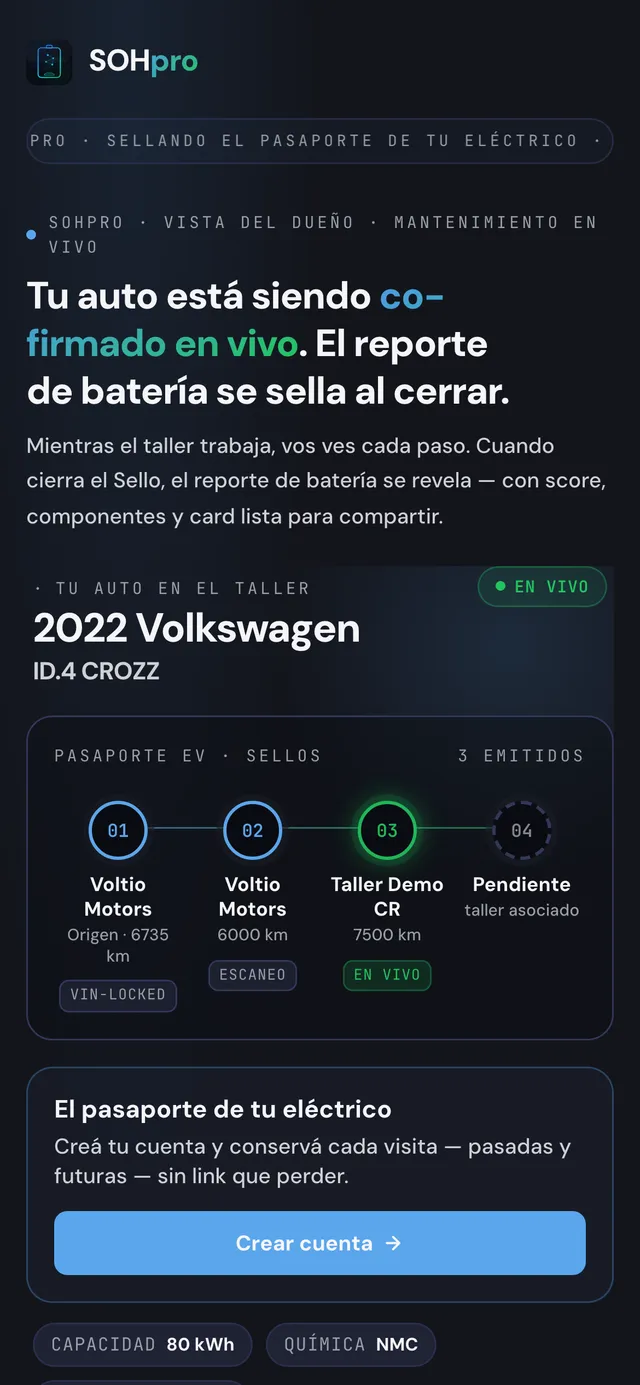
There's a second story here, and it's for the dealers. The shop that delivers the new EV and runs the first scan doesn't just give the customer good service — it writes itself in as the first chapter of that car's passport, the very one you see above: the delivery seal opens the page, each visit adds its own, and on resale day the buyer receives the whole film, not a loose snapshot.
Every maintenance visit adds a scan. When the car is resold, years later, the passport will still point back to that shop as the one that saw it born and looked after it. It's loyalty that doesn't feel like marketing: it feels like a well-kept history.
"For the dealer, the delivery scan is the easiest play there is: it costs next to nothing, it delights the customer, and it turns every EV they sell into a long-term relationship instead of a transaction that ends the moment the car leaves the lot." — Alonso Aguilar
More than the battery: a living, multi-shop history
There's a common misunderstanding: that this passport is "one shop's thing." It isn't. The history doesn't belong to a dealer — it belongs to the car, it lives at the VIN. Any partner shop can add its seal, so if you change shops, cities, or even owners, the history doesn't break: it simply keeps growing. It's a multi-shop record, not the private notebook of a single location.
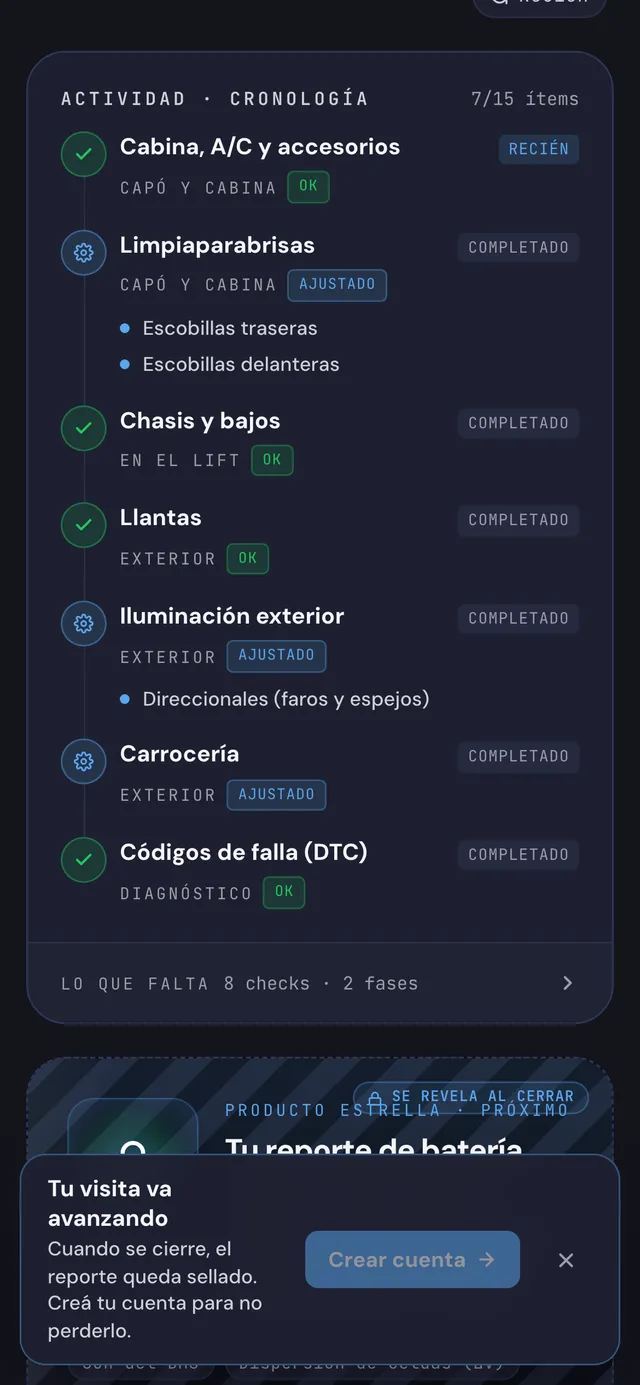
And it doesn't stop at the battery. Every visit is tracked live from your phone: you see the reading as the technician works, and the seal lands in your passport the moment the shop closes it out — no chasing an email, no waiting for the PDF that shows up three days later. Each seal leaves a record of the vehicle's condition at that moment, not just the SOH. Over the years, the passport stops being "the battery number" and becomes something closer to the car's complete medical record.
A quality seal that protects both sides
Starting the passport on delivery day isn't only your peace of mind: it's a quality seal that benefits everyone. For you, the buyer, it's the confidence of knowing — in writing, from day one — exactly what condition you received your car in, with no promise to lean on. And for the dealer or importer who sold it to you, it's documented proof of the quality they delivered: a dated, co-signed record of the vehicle's condition as it left their hands. The passport doesn't serve one side against the other — it backs them both.
For EVs that arrive imported, that first chapter has a name of its own: the import seal. The importer scans the car and seals it the moment it comes in, and that seal is etched in as the first page of the passport, tied to the VIN. It fixes the starting point at the exact instant the vehicle enters the market, and it becomes the serious importer's best calling card: proof of the condition each car was delivered in (we tell it from their side in the battery as a sales argument).
How to get started
You don't need anything special. The day you pick up your new EV, ask your dealer or trusted shop to run a battery scan and log it in your electric's passport. It's quick, it needs no special hardware — the diagnostic the shop's tool already produces is enough — and it stays tied to the VIN forever.
The best moment to start caring for your battery's health isn't when something goes wrong, nor when you're about to sell. It's day one, when everything is perfect and worth putting on the record.
"I picture a market where every used EV is offered with its story laid clearly on the table — how old it is, how well its battery was cared for, how it held up over time. That transparency is what's going to drive the resale market — and a used car you can trust is what ends up growing electric mobility across the whole region. That inspiration is where your electric's passport was born." — Alonso Aguilar, Founder & CEO
Just bought an EV? Ask for your delivery scan and start your electric's passport from kilometer zero. Learn more at SOHpro.